
Elastic Stockinette Uses: Retention, Liners and Support
Explore elastic stockinette uses for dressing retention, liners and support, with the specification details buyers need before choosing a tubular bandage.
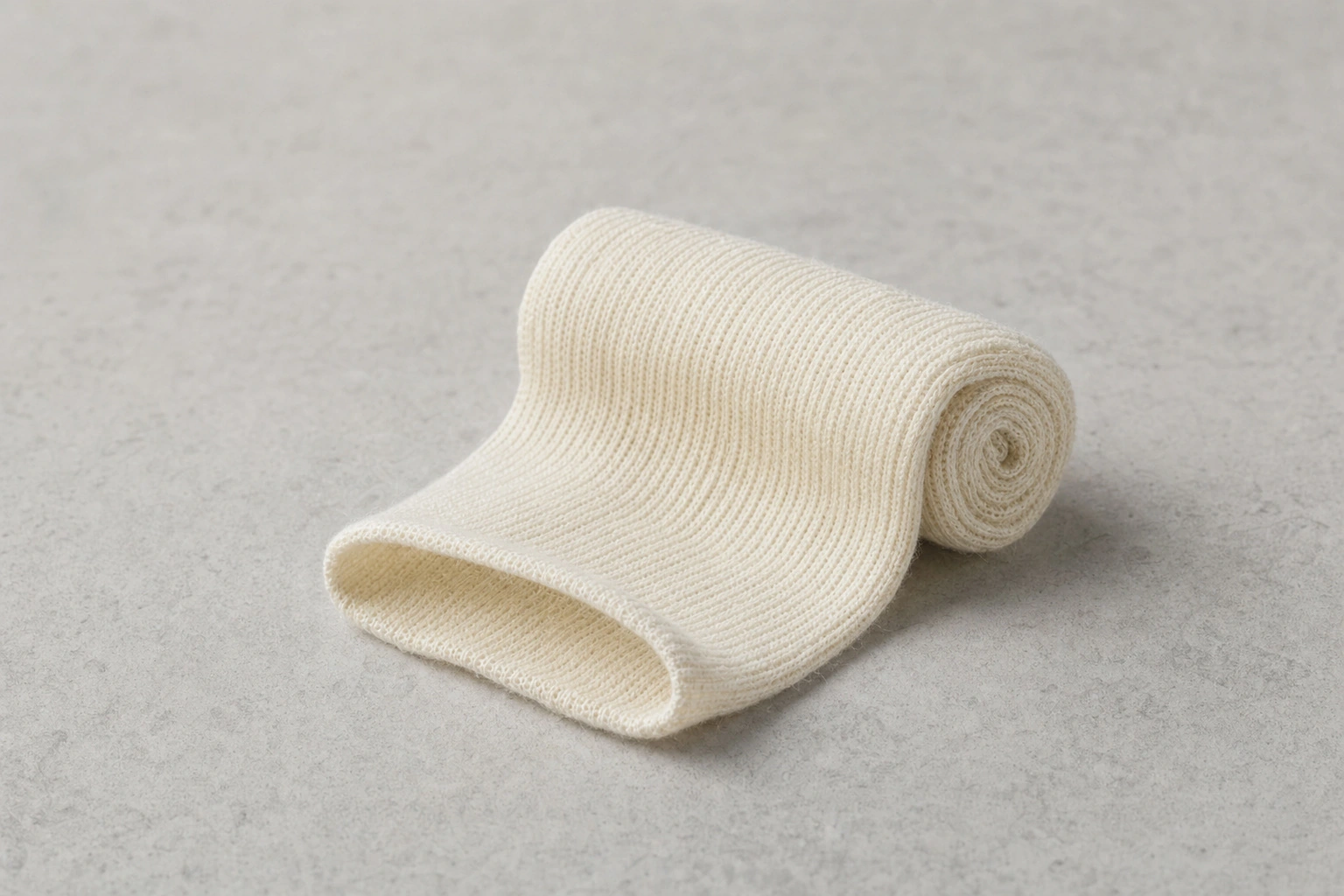
Elastic stockinette is used for dressing retention, protective lining and, in products designed and tested for it, support or compression. These are different jobs. Before choosing a tubular bandage, identify what the finished product must do: hold a dressing, provide an interface layer, or deliver a specified level of support.
Holding a dressing in place
A retention tube fits over a dressing to help keep it in position. This can be useful where a tubular format is preferable to fastening the dressing with adhesive. For example, Mölnlycke describes Tubifast as an elasticated dressing-retention bandage. That is a product-specific intended use, not evidence that every stretchy stockinette performs the same way.
For a distributor assembling a dressing-retention range, the useful questions are about the required fit, stretch in each direction, edge behaviour and packaging. A sample should be evaluated over the intended dressing arrangement, rather than judging the fabric only while it is flat on a desk. Our wound-care sourcing page explains what to include in this type of enquiry.
A liner beneath another bandaging layer
Some elasticated tubes serve as skin coverings or undercast liners. Mölnlycke's Tubifast product information lists skin covering and undercast use alongside dressing retention. For this role, the tube is one component within a specified system.
Make clear whether you are buying a liner alone or a complete bandaging product. In a multilayer system, do not attribute the function of the outer layers to the stockinette underneath. This distinction also matters when sourcing stockinette for compression and lymphoedema systems.
Support and compression require a separate specification
Elastic tubular support bandages are another product category. Mölnlycke, for example, describes Tubigrip as a tubular support bandage. Its stated performance belongs to that product and its instructions.
“Elastic” by itself is not a pressure rating. A purchasing specification for support or compression must identify the required performance, sizes, test method and intended application. Clinical selection and application belong to a qualified professional using the finished product's instructions; a supplier enquiry should not substitute a guessed pressure or an informal stretch test.
Spandex or rubber yarn: what should the order say?
Tahir Collection manufactures elastic tubular bandage using spandex or rubber yarn. State which you require, together with the full composition and any latex-related purchasing restriction. Choosing spandex is not, by itself, proof that a finished article has a verified latex-free claim.
A useful enquiry might read: “Tubular fabric for a dressing-retention product; required relaxed flat width and length attached; specify yarn composition, stretch and recovery requirements, packing and destination.” If the intended product is a support bandage, name that function explicitly and attach its performance requirements instead.
Is elastic stockinette the same as cotton stockinette?
The names describe different things. Cotton identifies a fibre; elastic describes behaviour or an elastic-yarn construction. A knitted cotton tube can stretch without being a tested compression product. Read our cotton stockinette uses guide when the requirement is primarily for a cotton liner. For an elastic product, send your intended use and specification with a sample request.