
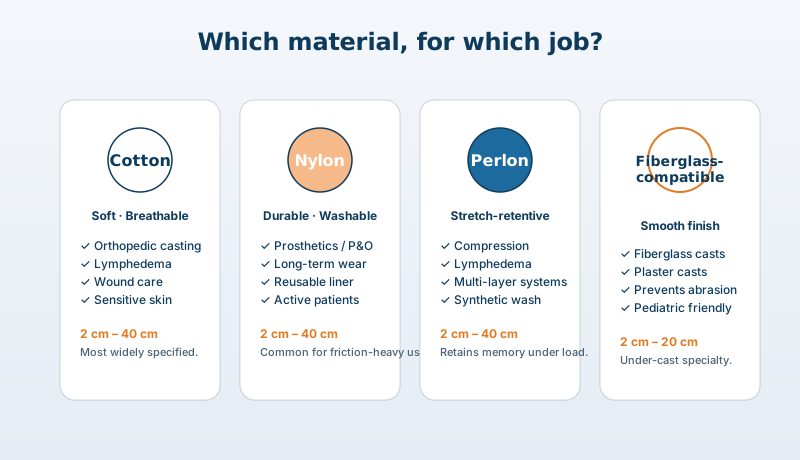
Use cotton for orthopedic casting and wound care. Use perlon for lymphedema compression. Use nylon for prosthetics and daily-wear applications. Use fiberglass-compatible specifically under fiberglass casts. When in doubt, cotton is a common starting point.
Complete Material Comparison Table
| Property | Cotton | Nylon | Perlon | Fiberglass-Compat. |
|---|---|---|---|---|
| Raw Material | 100% Natural Cotton | Polyamide (synthetic) | Polyamide-6 (synthetic) | Smooth-finish knit |
| Breathability | Common | Moderate | Low–Moderate | Moderate |
| Stretch | Good | Good | Common (retention) | Good |
| Washable / Reusable | Limited | Yes | Yes | No (single-use) |
| Skin Softness | Common | Good | Good | Good (smooth) |
| Latex-Free | ✅ | ✅ | ✅ | ✅ |
| Lay-flat Widths Available | 2–40 cm | 2–40 cm | 2–40 cm | 2–20 inches (5.08–50.8 cm) |
| Common For | Casting, wound care | P&O, liners | Compression therapy | Fiberglass casts |
| Price | Lowest | Moderate | Moderate | Moderate |
Cotton Stockinette — When to Choose It
Cotton tubular stockinette is a commonly specified stockinette in medical settings. It is often chosen when:
- Orthopedic casting — under plaster or fiberglass casts, cotton is the clinical standard
- Wound care — breathable and skin-gentle for patients with fragile skin
- Lymphedema (first layer) — standard choice for most compression therapy protocols
- Garment & apparel — cost-effective for industrial applications up to 40 cm
→ Cotton stockinette full specifications →
Nylon Stockinette — When to Choose It
Nylon is the preferred material when durability and repeated washing are required:
- Prosthetics & orthotics — daily-wear socket liners that are washed frequently
- Cotton allergy patients — synthetic alternative for skin-sensitive patients
- Long-term wear applications — where cotton would degrade
→ Nylon stockinette full specifications →
Perlon Stockinette — When to Choose It
Perlon (a form of polyamide-6) offers stretch-retention — the key property for compression applications:
- Lymphedema multi-layer bandaging — maintains consistent interface pressure
- Compression therapy systems — where elastic recovery is critical between applications
- German and European markets — perlon is the traditional specification in German lymphology protocols (Schlauchbandage)
→ Perlon stockinette full specifications →
Fiberglass-Compatible — When to Choose It
Specifically engineered for fiberglass cast applications where the rougher texture of fiberglass tape requires a smoother underliner:
- Under fiberglass casting tape to prevent skin irritation
- Pediatric orthopedic casting where skin protection is especially important
- Not for compression or P&O — designed specifically for casting applications
→ Fiberglass-compatible stockinette specifications →
Quick Reference: Which Material by Application
| Application | First Choice | Alternative |
|---|---|---|
| Orthopedic casting (plaster) | Cotton | Fiberglass-Compatible |
| Orthopedic casting (fiberglass) | Fiberglass-Compatible | Cotton |
| Lymphedema compression | Cotton | Perlon |
| Multi-layer compression bandaging | Perlon | Cotton |
| Prosthetics socket liner | Nylon | Perlon |
| Wound care / dressing fixation | Cotton | — |
| Garment / apparel (industrial) | Cotton | Nylon |